Glossary, FAQs & Resources
Comprehensive cashmere terminology, 20+ frequently asked questions, and a curated library of books, organisations and further reading.
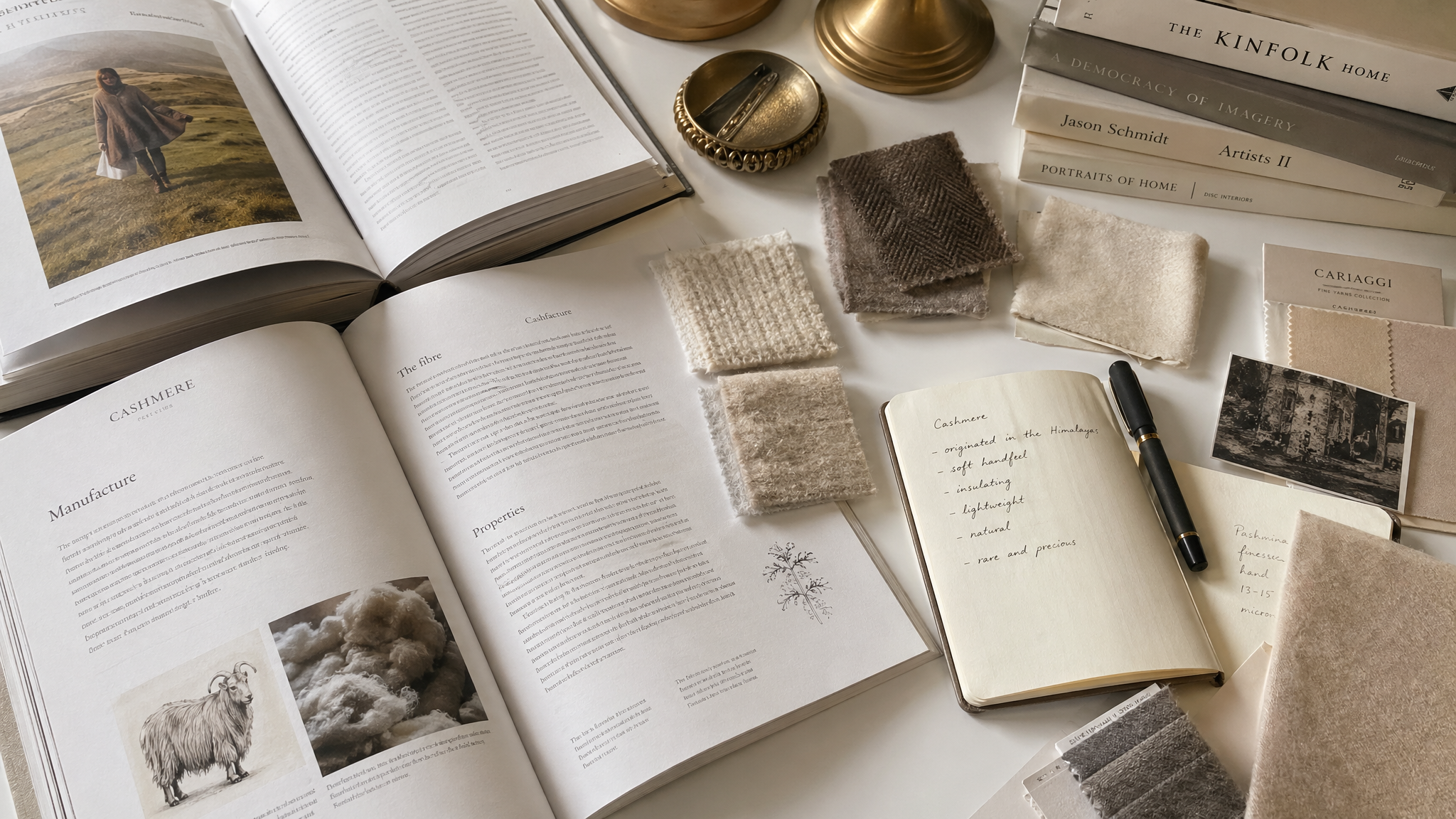

Reference materials
Premium cashmere from the Alashan (Alxa) plateau of Inner Mongolia, China. Considered among the finest Chinese cashmere, averaging 15–16 µm. The arid desert environment forces goats to develop a particularly fine undercoat for insulation against extreme temperature swings.
Cashmere produced using traditional, hand-based methods at every stage — from hand-combing through hand-spinning to handloom weaving. Distinguished from industrial cashmere by higher labour intensity, lower volume, and typically superior quality and traceability.
The characteristic soft, slightly raised surface texture of well-finished cashmere. Bloom develops during wet-finishing when the fibre's natural scales open slightly in warm water and close during drying, creating a cloud-like surface quality. High-quality bloom is a mark of both excellent raw material and superior finishing.
The use of distributed ledger technology to create tamper-proof records of a cashmere product's journey from herder to consumer. Each stage of production is recorded as an immutable block, allowing buyers to scan a QR code and verify origin, fibre testing results, and ethical certifications. Adopted by a growing number of premium Indian and Mongolian cashmere brands since 2020.
A finishing treatment using biological enzymes to reduce pilling potential and improve softness in cashmere and wool fabrics. Enzymes partially digest protruding surface fibres, producing a smoother handle. However, enzyme detergents should never be used for home washing — they continue to break down protein fibres, weakening the fabric over time.
An informal term for cashmere produced under independently verified sustainable and ethical standards — covering rangeland health, animal welfare, herder livelihoods, water use, and chemical management. Eco-cashmere is not a formal certification; look instead for GCS, SFA, or GOTS marks as objective verification of sustainability claims.
The scientific name for the domesticated goat species that includes the Cashmere goat. The subspecies Capra hircus laniger is specifically the fibre-bearing variety capable of producing usable cashmere undercoat.
The specific breed of cashmere goat indigenous to the Changtang plateau of Ladakh, India, at altitudes above 4,500m. Produces the finest natural cashmere (Pashmina) averaging 12–16 µm. Raised by the Changpa nomadic community under traditional herding practices.
The nomadic/semi-nomadic pastoralist community of the Changtang plateau in Ladakh, India. The Changpa have herded Changthangi goats for over 1,000 years and are the original custodians of Pashmina production knowledge.
The natural wave or curl pattern of a fibre. In cashmere, crimp is measured as the number of waves per centimetre (approximately 35/cm). Higher crimp creates greater air-trapping capacity (warmth), better cohesion during spinning, and a bouncier handle. Crimp is reduced by heat, mechanical stress, or chemical treatment.
An autonomous region of northern China responsible for approximately 30–40% of the world's raw cashmere supply. The dramatic expansion of goat herds driven by fast-fashion demand — from ~5 million in 1990 to over 27 million by 2016 — has been the primary driver of overgrazing and land degradation in the sector.
The International Organisation for Standardisation standard defining cashmere fibre: maximum diameter of 19 µm, with no more than 3% of fibres exceeding 30 µm. This standard forms the legal basis for cashmere labelling in most regulated markets and is the benchmark against which fibre testing laboratories assess compliance.
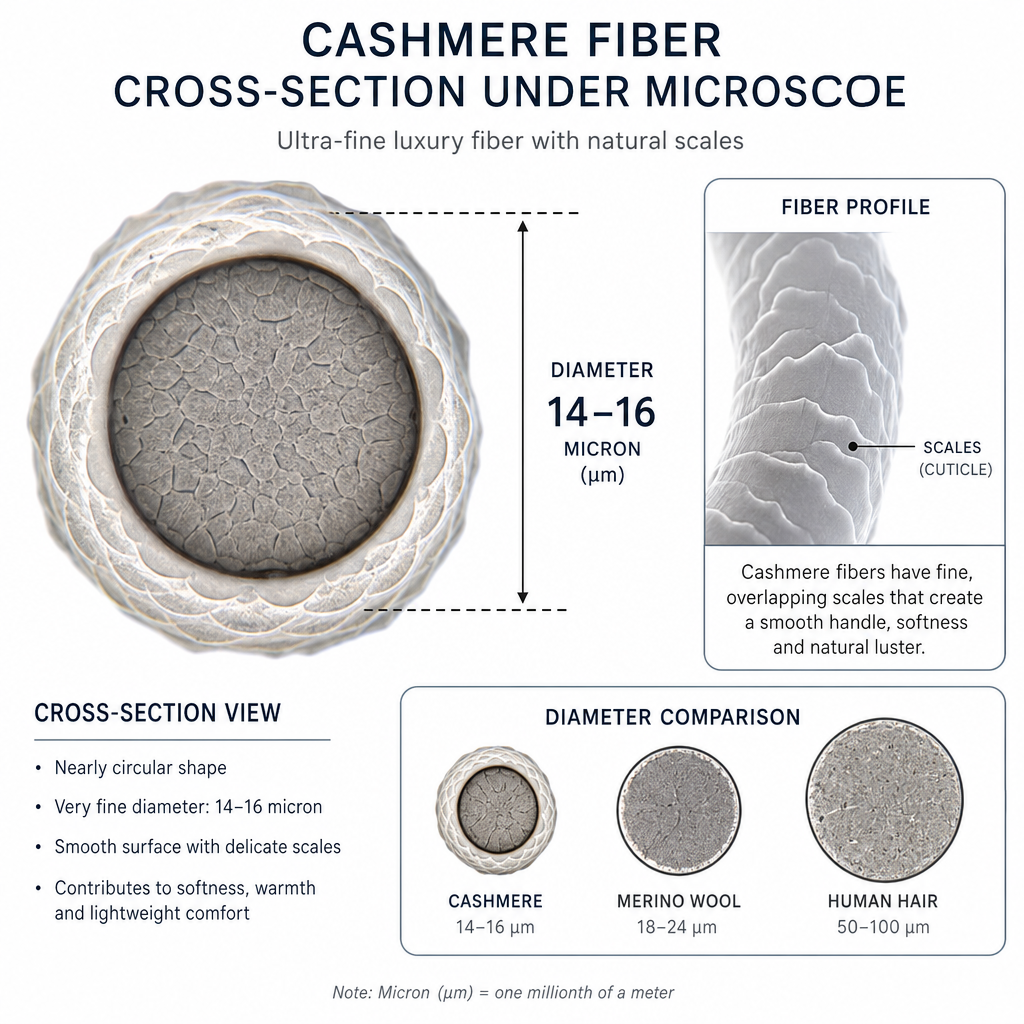
The critical process of separating fine cashmere undercoat fibres (14–19 µm) from coarse outer guard-hair (30–80 µm) after combing. Can be done by hand (traditional) or by Kasha dehairing machine (industrial). Dehairing efficiency determines the percentage of coarse fibres in the final product — a key quality determinant.
A matching pair of Kashmiri shawls woven simultaneously on adjacent looms so they are identical in every detail. Commissioned by Mughal emperors as gifts of the highest honour — wearing a matching pair indicated imperial favour. A master achievement of Kashmiri weaving skill.
Irreversible matting and shrinking of protein fibres (wool, cashmere) caused by mechanical agitation combined with heat and moisture. The scales on protein fibres interlock when disturbed, causing permanent dimensional change. The primary reason cashmere must never be machine-washed in hot water or wrung when wet.
A controlled wet-finishing process that compresses woven fabric, increasing density, improving handle and creating a fuller, softer texture. Fulling is central to the development of cashmere's characteristic bloom. The degree of fulling determines whether the finished fabric is lightweight and drapey or denser and warmer.
The leading animal welfare and land management certification for cashmere, issued by the Aid by Trade Foundation. GCS requires independent annual audits covering: land use per animal, animal welfare (access to food, water, freedom from pain), and herd management practices. Available at goodcashmerestandard.org.
A legal certification granted to products with a specific geographical origin and qualities linked to that origin. "Kashmiri Pashmina" received GI protection in India in 2008, restricting use of the name to authenticated handwoven Pashmina from the Kashmir Valley. The "Pashmina Mark" logo identifies GI-protected products.
The industry's primary quality classification system: Grade A (≤15.5 µm, ≥36mm length) is the finest; Grade B (15.5–17 µm, 32–36mm) is excellent standard; Grade C (17–19 µm, 28–34mm) is good-quality but coarser. No single global grading body exists; these designations are industry convention.
The tactile quality of a fabric — its feel, drape, and response to touch. "Hand" is a holistic sensory evaluation encompassing softness, smoothness, warmth, elasticity and drape. Experienced textile professionals can assess fibre grade, finishing quality and construction from hand alone. Developing a discerning "hand" is the foundation of cashmere expertise.
Nm (Numero Metrico) expresses yarn fineness as the number of metres per gram. A 2/48 Nm yarn means two strands of 48 m/g yarn are plied together; the resultant yarn is 24 m/g. Higher Nm = finer, lighter yarn. Authentic hand-spun Pashmina achieves 2/100 Nm or finer — among the thinnest yarns produced from any natural fibre.
Dyes derived from plant, mineral or insect sources used in traditional cashmere and Pashmina dyeing. Historically used sources include walnut husks (brown), saffron (yellow), indigo (blue), lac insects (red) and pomegranate rind (gold). Natural dyes produce softer, more complex colour tones than synthetic alternatives and are biodegradable, though some require metallic mordants.
A certification standard verifying the presence and amount of certified organic material in a final product. For cashmere, OCS traces the chain of custody from the organically raised goat through to the finished garment. Issued by Textile Exchange and verified by accredited third-party certification bodies.
The degradation of pastureland through excessive livestock density, preventing grasses and shrubs from recovering between grazing cycles. The tripling of Mongolian goat herds driven by fast-fashion demand resulted in approximately 70% of Mongolia's grasslands showing signs of degradation and ~3,600 km² per year of Gobi Desert expansion by the mid-2010s.
The most technically demanding Kashmiri weaving technique, using small wooden spools (kanis) instead of a conventional shuttle to create complex multi-coloured patterns. A single kani shawl requires 100–300 individual kanis, takes 2–5 years to complete, and represents the pinnacle of Kashmiri textile art. The technique was developed under Mughal patronage in the 15th century.
An industrial dehairing machine that uses the difference in fibre curvature between cashmere undercoat and guard-hair to separate them. Developed in the 1950s and now standard in commercial cashmere processing. Named after its inventor. Still requires skilled operation to avoid fibre damage.
Objective laboratory methods for verifying cashmere quality and authenticity. Key tests include: OFDA (Optical Fibre Diameter Analyser) or Laserscan for micron measurement; ASTM D629 for fibre content by weight; FTIR spectroscopy for species identification; and scanning electron microscopy for scale pattern analysis. Third-party testing can definitively distinguish cashmere from wool, acrylic, and other substitutes.
Natural waxy substance secreted by wool and cashmere fibres as a protective coating. Removed during scouring/washing of raw fibre. Small residual amounts remaining after processing contribute to the natural "feel" of quality cashmere. Some care products replace lanolin after washing to maintain fibre condition.
One millionth of a metre (0.001 mm). The standard unit for measuring textile fibre diameter. Human hair is approximately 70–80 µm; fine cashmere ranges from 14–19 µm; the finest Pashmina can be as fine as 12–13 µm. Lower micron count = finer, softer, more expensive fibre.
The brief spring period (typically March–May) when cashmere goats naturally shed their winter undercoat. Hand-combing during moulting captures fibre at its ideal length (34–38 mm) before it falls and is lost. Shearing, by contrast, yields shorter fibre and coarser averages. Moulting season is the single most time-constrained bottleneck in the entire cashmere supply chain.
The raw fine undercoat of the Changthangi goat before it is processed into yarn or fabric. "Pashm" is the root of "Pashmina." In Ladakhi and Kashmiri usage, pashm specifically refers to the raw fibre as combed from the animal — before washing, dehairing or spinning.
1. (Fibre) Ultra-fine cashmere (≤16 µm) from the Changthangi goat of Ladakh. 2. (Textile) A shawl or fabric woven from this fibre in the traditional handloom workshops of the Kashmir Valley. Authentic Pashmina carries India's GI tag. Often misused commercially for cheap acrylic or viscose scarves, which have no connection to true Pashmina.
The formation of small fibre balls (pills) on the fabric surface due to friction during wear. Caused by short fibres migrating to the surface and tangling. Normal in the break-in period of all cashmere (first 3–5 wears). Excessive ongoing pilling indicates short staple length or poor construction quality. Easily removed with a cashmere comb or fabric shaver.
The number of yarns twisted together to form the final yarn strand. Single-ply (1-ply) is lightweight; 2-ply is warmer and more durable; 4-ply (chunky) is the warmest. Higher ply increases durability and reduces pilling but adds weight. Most premium cashmere sweaters are 2-ply. Not to be confused with fibre grade — ply and micron count are independent quality dimensions.
The fine, soft inner layer of fibre grown beneath the coarser outer guard-hair coat of cashmere goats. The undercoat (pashm) is the commercially valuable portion meeting ISO 3715 standards. It develops its maximum fineness in animals living at high altitudes in extreme cold, as environmental stress drives the production of finer insulating fibres. The outer guard-hair must be removed through dehairing.
A wild South American camelid (Vicugna vicugna) producing the world's finest natural fibre at 12–13 µm — even finer than the best Pashmina. Vicuña is legally protected and can only be shorn every 2–3 years under strictly regulated conditions. It yields approximately 200–250 g per shearing, making it far rarer than cashmere. Finished vicuña cloth commands prices of $1,500–$3,000+ per metre.
New cashmere fibre that has never been previously processed, as opposed to recycled or reclaimed cashmere. Virgin cashmere retains full fibre length and integrity. Its production emits approximately 100 kg CO₂e per kilogram of fibre — compared to ~14 kg CO₂e for recycled cashmere, an 86% carbon reduction (Textile Exchange, 2021).
Cashmere fibre recovered from post-consumer garments or pre-consumer manufacturing waste, reprocessed into new yarn through shredding and re-spinning. Recycled cashmere emits approximately 14 kg CO₂e per kilogram — 86% less than virgin. Certified under the Global Recycled Standard (GRS). Fibre length is shorter after reprocessing, so recycled cashmere typically pills more than virgin — but represents the lowest environmental impact option.
The most common industrial yarn spinning method. Fibre is drawn through a rotating ring and traveller to add twist. Produces consistent, strong yarn. Most commercial cashmere is ring-spun. The alternative — hand-spinning on a takli — produces less consistent but more characterful yarn used in authentic Pashmina.
An international NGO focused on the sustainable production of natural fibres. The SFA Standard for Cashmere covers rangeland health, animal welfare, herder livelihoods and supply chain transparency. Partners include WWF, major fashion brands, and herder cooperatives. Particularly active in Mongolia.
Fine needle embroidery worked on Pashmina using silk or cashmere thread. Traditional sozni patterns depict Kashmiri flora — chinar leaves, lotus, almond blossom. A master sozni artisan can spend 18 months on a single shawl. Executed from the reverse side, requiring the craftsperson to visualise the pattern in mirror image.
The natural length of a fibre as harvested. In cashmere, ideal staple length is 34–38mm. Longer fibres produce stronger, less pilling yarn because they overlap more during spinning. Short-staple fibre (below 30mm) — often the result of shearing rather than combing — produces weaker yarn prone to excessive pilling.
The washing stage of raw cashmere fibre to remove vegetable matter, grease, dust and sweat accumulated during herding and storage. Scouring uses warm water (carefully controlled to avoid felting), mild detergent, and mechanical action. The scouring bath's temperature, pH and duration are critical variables — too hot or too alkaline damages the fibre's protein structure and degrades its characteristic softness.
The degree to which a brand can trace and disclose the full journey of its cashmere from herder to consumer — including the names and locations of farms, dehairing mills, spinners, dyers and manufacturers. Transparency is increasingly demanded by regulators and consumers. Blockchain technology and QR-coded certificates of origin are emerging tools for verifiable transparency in the premium cashmere sector.
A small, hand-held wooden or metal spinning spindle used to spin cashmere and cotton into yarn by hand. The primary spinning tool for authentic Pashmina production. Produces yarn so fine (2/48 Nm or finer) that it would snap if spun on a powered machine at equivalent speed. Mastery of the takli requires years of practice.
A textile weave pattern where each weft thread passes over one or more warp threads and under two or more, creating a diagonal rib effect. Twill weaves produce a denser, more durable fabric than plain weaves from the same yarn — used for cashmere suiting fabrics, overcoat cloth, and structured accessories. Herringbone and houndstooth are both variants of twill weave construction.
In weaving, the warp is the set of threads held taut on the loom (running lengthwise); the weft is the thread passed back and forth across the warp to create the fabric. In traditional Pashmina weaving, silk warp threads are often used with cashmere weft — this improves structural strength while maintaining the luxury handle of cashmere.
A measure of yarn fineness expressed as metres of yarn per gram (Metric count, Nm). Higher Nm = finer yarn. Traditional Pashmina uses yarn of 2/48 Nm (48 metres per gram, doubled). Most commercial cashmere knitwear uses 2/28 Nm to 2/48 Nm. Finer yarn requires more skill to spin and weave, commands a higher price, and produces a lighter, more luxurious garment.
10 questions covering fiber science, heritage, quality, sustainability and care. How much do you really know about the world's finest fibre?
📚 Books
The Golden Fleece: The Story of Cashmere
A comprehensive history of Kashmiri cashmere from its Mughal origins to the present day, with particular focus on Indian heritage, artisan communities, and the challenges facing traditional production.
Shawls of the East: From Kashmir to Paisley
The definitive visual history of Kashmiri shawl traditions, covering the full arc from Mughal patronage to European fashion, with extraordinary textile photography and historical documentation.
Overdressed: The Shockingly High Cost of Cheap Fashion
While not cashmere-specific, this essential read on fast fashion's environmental and social impact provides crucial context for understanding why cheap "cashmere" is both a quality and sustainability problem.
Cashmere: Botany, Zoology, History and Technology
Technical reference covering the science of cashmere fibre from biological origins to processing technology. Authoritative source for micron standards, grading criteria, and processing specifications.
🌐 Key Organisations & Standards Bodies
Good Cashmere Standard (GCS)
The leading animal welfare and land management certification for cashmere. Issued by Aid by Trade Foundation. Brand directory and certification verification available on their website.
Sustainable Fibre Alliance (SFA)
International organisation focused on sustainable natural fibre production. Particularly active in Mongolia; partners with WWF and major fashion brands on rangeland restoration.
Craft Development Institute, Srinagar
India's premier institution for documenting and developing traditional Kashmiri crafts. Offers training programs, research publications, and artisan certification for Pashmina and kani weaving.
IWTO — International Wool Textile Organisation
Sets technical standards for wool and specialty fibres including cashmere. ISO 3715 (the global cashmere standard) was developed through IWTO. Publishes annual fibre market reports and technical bulletins.
🎬 Documentaries & Video Resources
The True Cost (2015)
Examines the human and environmental cost of the global fashion industry. Essential context for understanding why sustainable, quality cashmere matters — and the consequences of prioritising price over principles.
The Changpa Nomads of Ladakh
Several documentary episodes have covered the Changpa community and their relationship with the Changthangi goat. Search National Geographic's archive for recent coverage of the Changtang plateau and Pashmina production.
Craft Documentation Project — Srinagar
Multiple YouTube channels document Kashmiri kani weaving, sozni embroidery and Pashmina production. Search "kani weaving Kashmir" or "Pashmina making process" for excellent artisan-led footage.
Textile Exchange Annual Preferred Fiber Reports
Annual industry reports covering cashmere, wool, and all major natural fibres with sustainability metrics, production volume data, and certification updates. Free to download from Textile Exchange's website.
Never Stop Learning About Cashmere
Subscribe to The Cashmere Insider for monthly deep-dives on quality, heritage, and sustainability.